Materials Library
What enters the studio, what changes, and what remains.
An evolving collection of geological matter, biological remains and manufactured fragments, followed from encounter through research and studio experimentation. Some enter artworks physically; others contribute a process, structure or way of thinking. What remains may be an object, image, cast, gesture or recurring question.
Casting does not merely reproduce an object. It gives material presence to what is no longer there.
Form is produced through contact with absence.
Material Correspondences
The studio operates as a changing field of relationships. Paintings, found coastal materials, casts and manufactured fragments are brought together provisionally, not as fixed categories, but to discover what passes between them.
Flint can be understood as a form of natural casting: silica accumulated and hardened within the cavities and porous structures of ancient seabeds.
Burnt wood retains the architecture of growth after combustion. Shell, concrete, plastic and compressed objects each hold the trace of forces acting upon them.
These arrangements allow geological, biological and human processes to encounter one another. Compression, erosion, burning, casting and displacement become related ways in which matter records contact, change and absence.
Materials are approached as active records of contact and change. Their physical presence may disappear from an artwork while their behaviours—casting, compression, erosion and burning—continue through it.

Material states
Encountered / Researching / Testing / Translated / Continuing
A material does not have to remain physically present in an artwork for its influence to remain
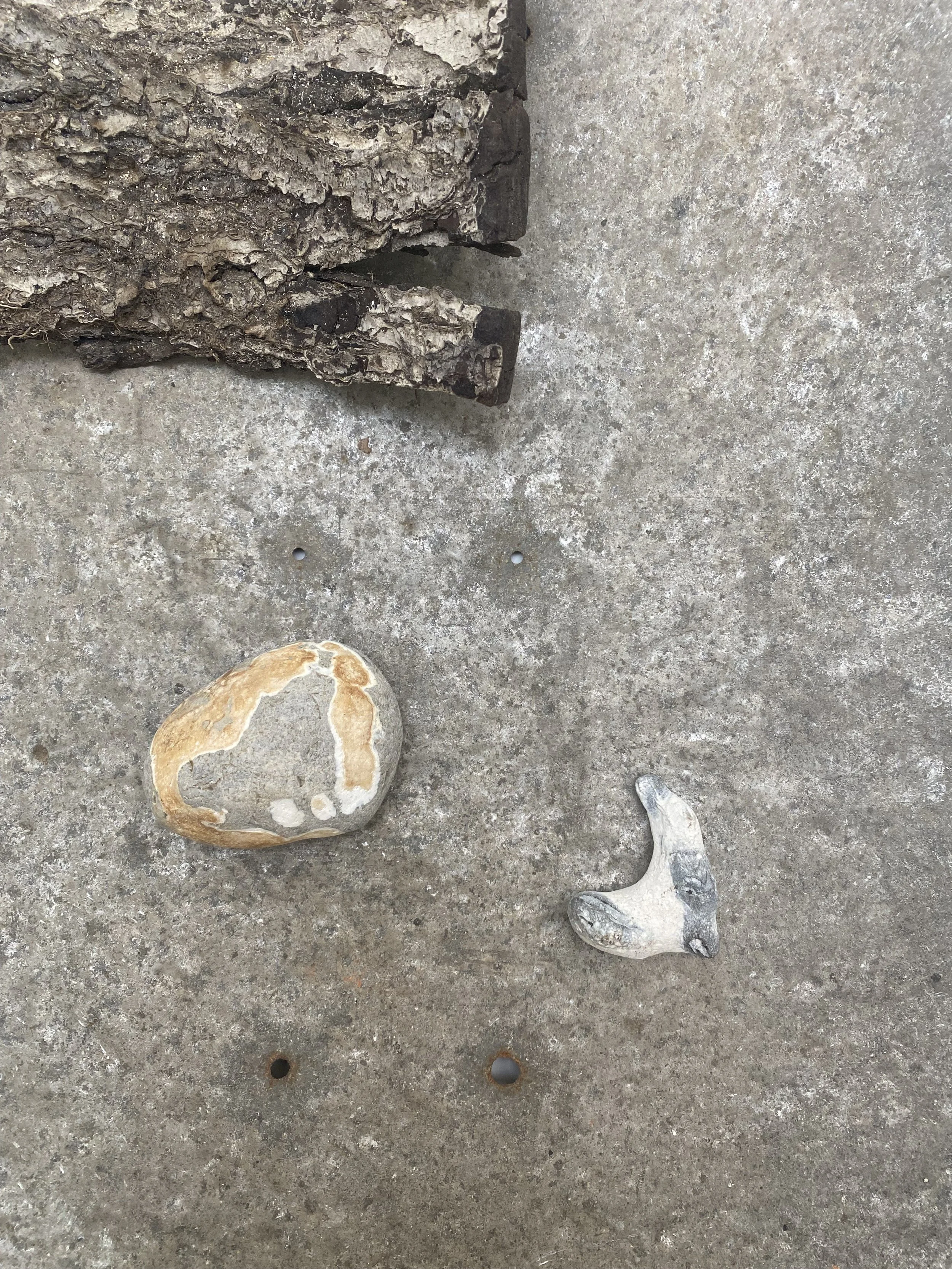
Flint: Ancient Future:
3D-printed form, found flint and Margate beach pebble.
Flint
Form produced through contact with absence
Substance
Flint is a dense form of silica found within chalk.
Formation
Silica accumulated and mineralised within cavities in ancient marine sediment. Its formation can be understood as a kind of natural casting: absence behaves like a mould and gradually acquires material presence.
Encounter
Flint is encountered throughout the Thanet coastline, where erosion releases it from the surrounding chalk.
Research
Its relationship with cavity, pressure and deep time introduced connections between casting, preservation and negative space.
Translation
Found flint appears within Ancient Future, positioned between a 3D-printed form and a beach pebble. Its formation has also informed experiments with casting the internal space of an oyster shell.
Afterlife
Flint continues through the practice as found object, geological archive and model for making.
Status: Continuing

Plastic: Traced Passage:
layered green painting containing forms traced from a blue plastic fragment.
Plastic
A temporary function with a geological afterlife
Substance
Plastic is a manufactured polymer capable of being moulded, stretched, coloured and formed into skins, containers and protective structures.
Formation
Unlike flint or shell, plastic is industrially produced. Yet its capacity to take the shape of a mould gives it an unexpected relationship with geological and biological processes.
Encounter
Plastic enters the studio through found coastal and roadside fragments, packaging, protective coverings and unidentified manufactured forms.
Research
Its apparent lightness and temporary purpose contrast with its material persistence. Once separated from its original function, plastic becomes difficult to date or classify.
Translation
A blue plastic fragment provided the outline traced into Traced Passage. Packaging forms have also been approached as ready-made moulds, allowing the negative spaces surrounding manufactured objects to become new forms.
Afterlife
Plastic remains within the practice as membrane, outline, cavity and artificial geology, even when the original object is absent.
Status: Continuing
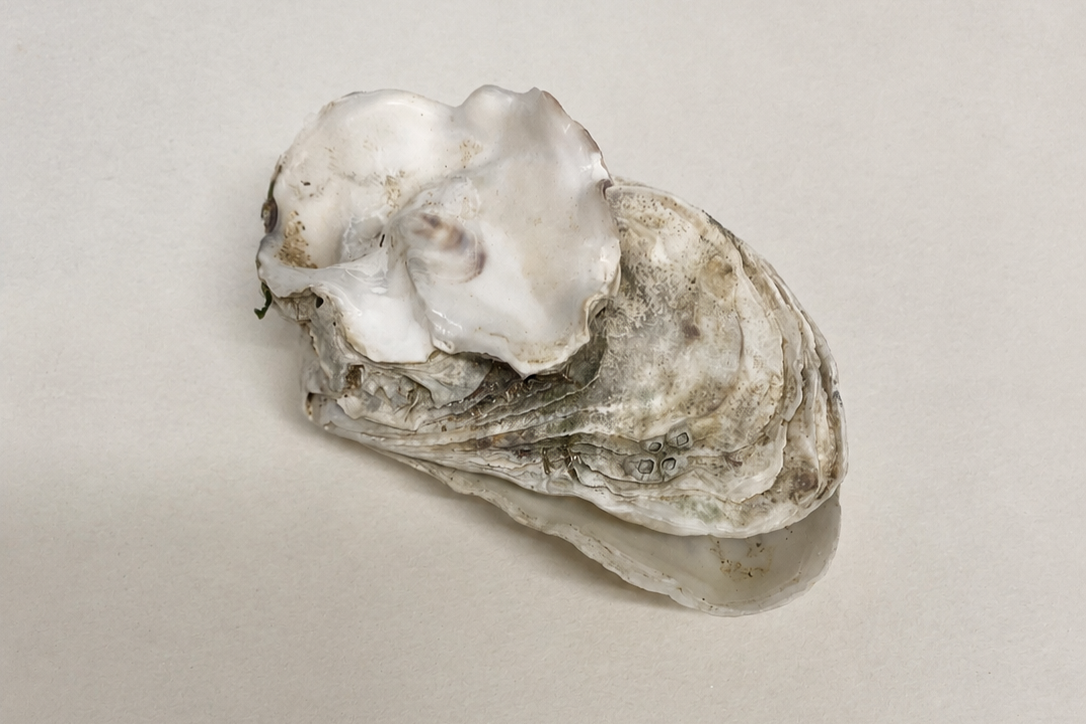
Oyster Shell:
Weathered oyster shell photographed alone on an off-white surface.
Oyster Shell
An organism, an architecture and a mould
Substance
An oyster shell is formed primarily from calcium carbonate, deposited layer by layer by a living organism.
Formation
Its irregular structure records growth, damage, repair and its continual negotiation with surrounding water.
Encounter
The shell connects the studio to the coastal and working histories of Thanet and Whitstable. Its exterior carries erosion and attachment, while its interior preserves the shape of a former living body.
Research
The empty shell raises a central question: can the space once occupied by an organism be understood as a material form in its own right?
Translation
Current experiments explore casting the shell’s internal negative space. The intention is not to reproduce the oyster but to give physical presence to the cavity it left behind, echoing the natural formation of flint.
Afterlife
Through casting, the shell becomes both object and mould. Its internal absence can be translated into a new solid form.
Status: Testing
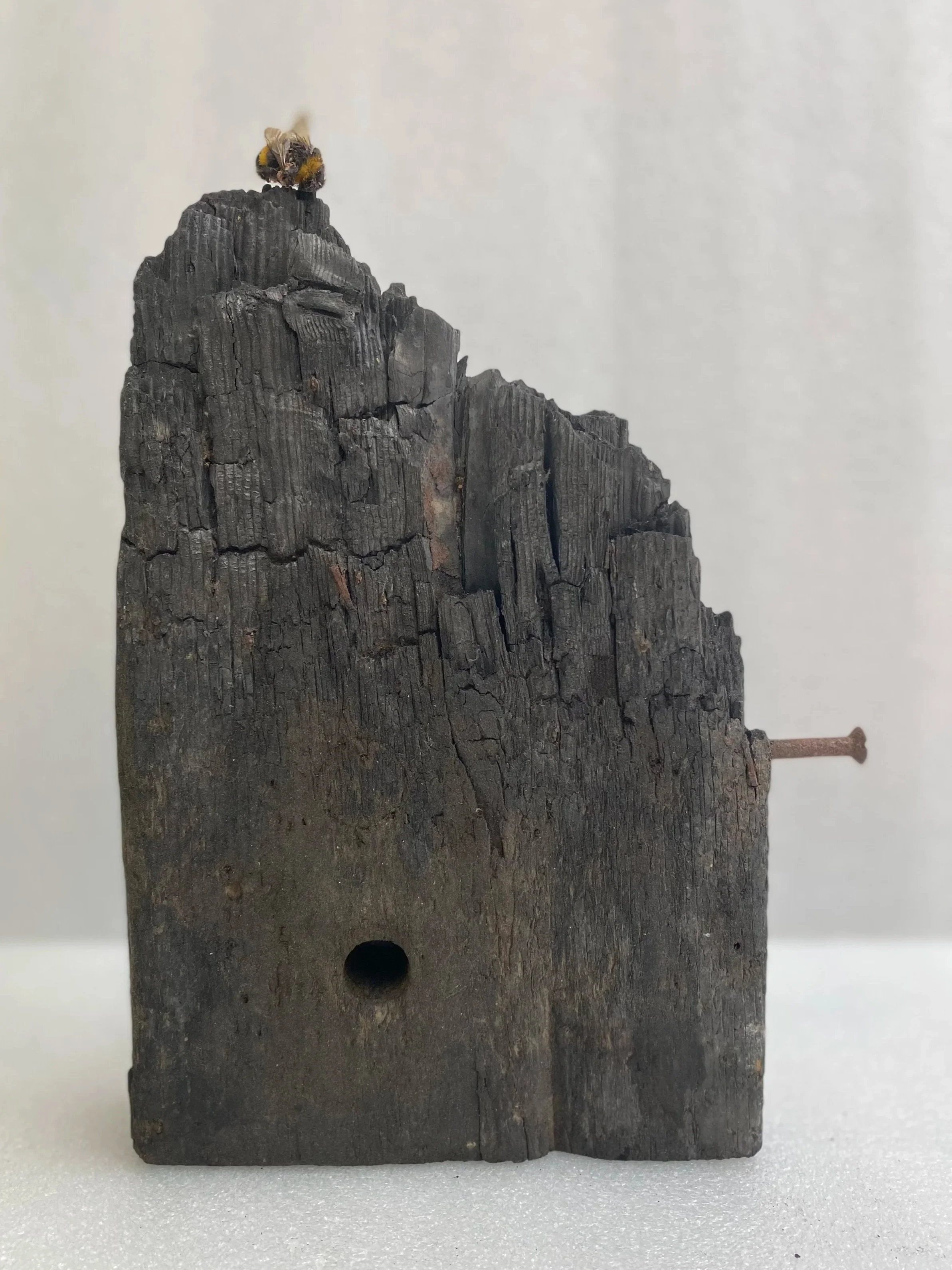
Burnt Wood: The Last Flight:
Found dead bumblebee resting on a vertical fragment of charred wood.
Burnt Wood
Destruction becoming preservation
Substance
Wood is a living structure transformed by fire into a dark, carbon-rich surface.
Formation
Burning removes and alters the outer layers while preserving the grain and history of growth beneath. Research into Japanese wood-charring processes introduced the paradox that controlled destruction can protect timber from later decay.
Encounter
Burnt and charred wood has entered the practice through found coastal fragments and studio arrangements.
Research
Its surface operates like a membrane between damage and protection, mortality and survival, past destruction and future preservation.
Translation
In The Last Flight, a found bee rests on charred wood. The relationship remains unresolved: the surface may suggest aftermath and death, but also shelter and protective architecture.
Afterlife
Burnt wood becomes a material record of duration, changed irreversibly, yet potentially made more resistant through that change.
Status: Continuing
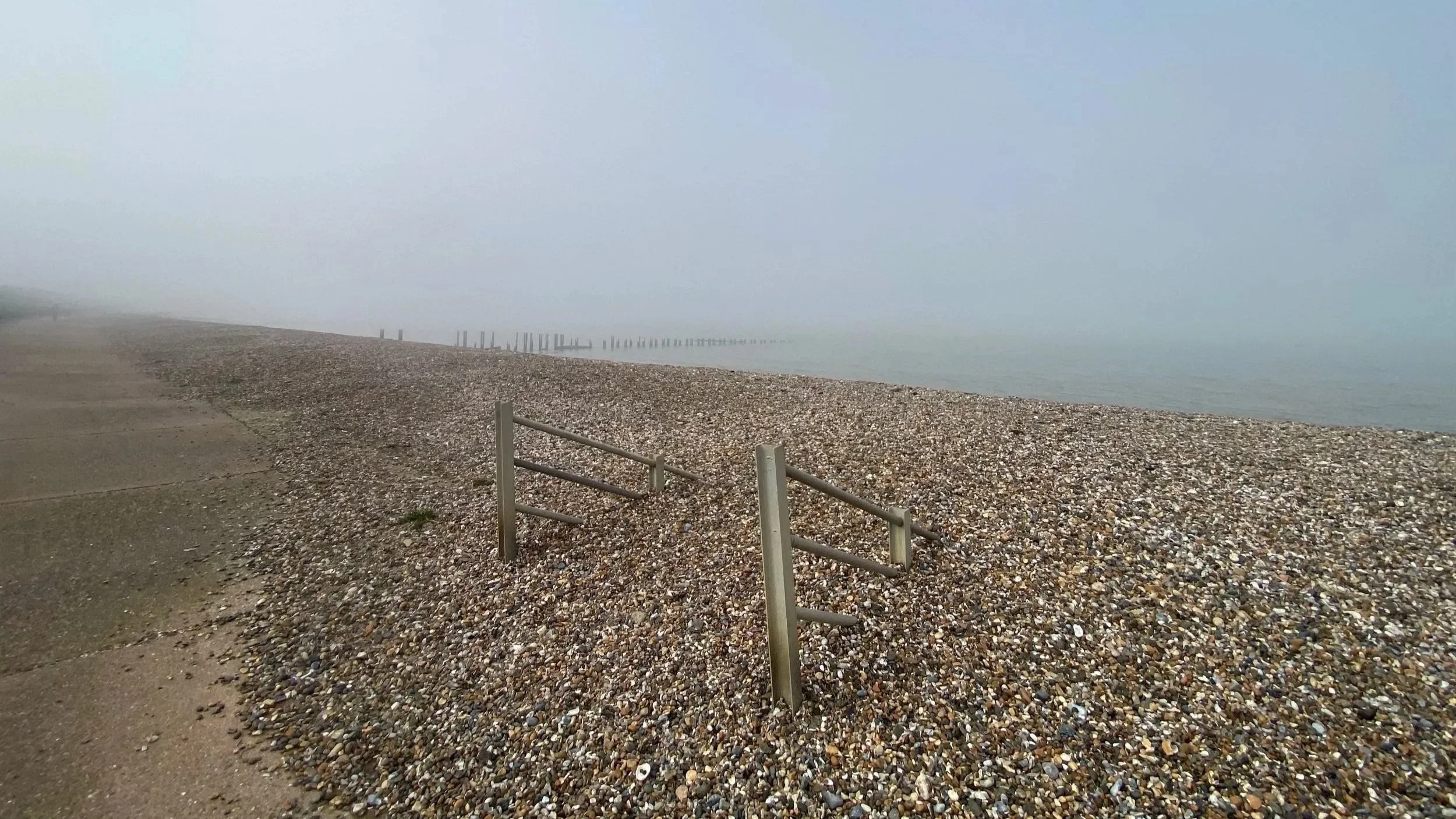
Shingle: Disappearing Access:
Beach steps and railings partly engulfed by shingle in fog.
Shingle
A landscape that continually reorganises itself
Substance
Shingle consists of stones repeatedly moved, rounded and redistributed through water, weather and human intervention.
Formation
It does not produce a permanently stable surface. Individual fragments accumulate temporarily before being displaced and reorganised.
Encounter
Research along the Thanet coast and at Dungeness has followed shingle as it gathers around steps, barriers, cables, roads and other constructed edges.
Research
Shingle reveals the coast as a mobile material system. It can protect, bury, expose and redirect, gradually rewriting attempts to control access or stabilise the shoreline.
Translation
In Disappearing Access, beach steps are almost engulfed by migrating shingle. The material is not treated as background but as an active force negotiating with human infrastructure.
Afterlife
Shingle continues through the work as a model of migration, accumulation and self-organisation: a landscape always in the process of becoming something else.
Status: Continuing
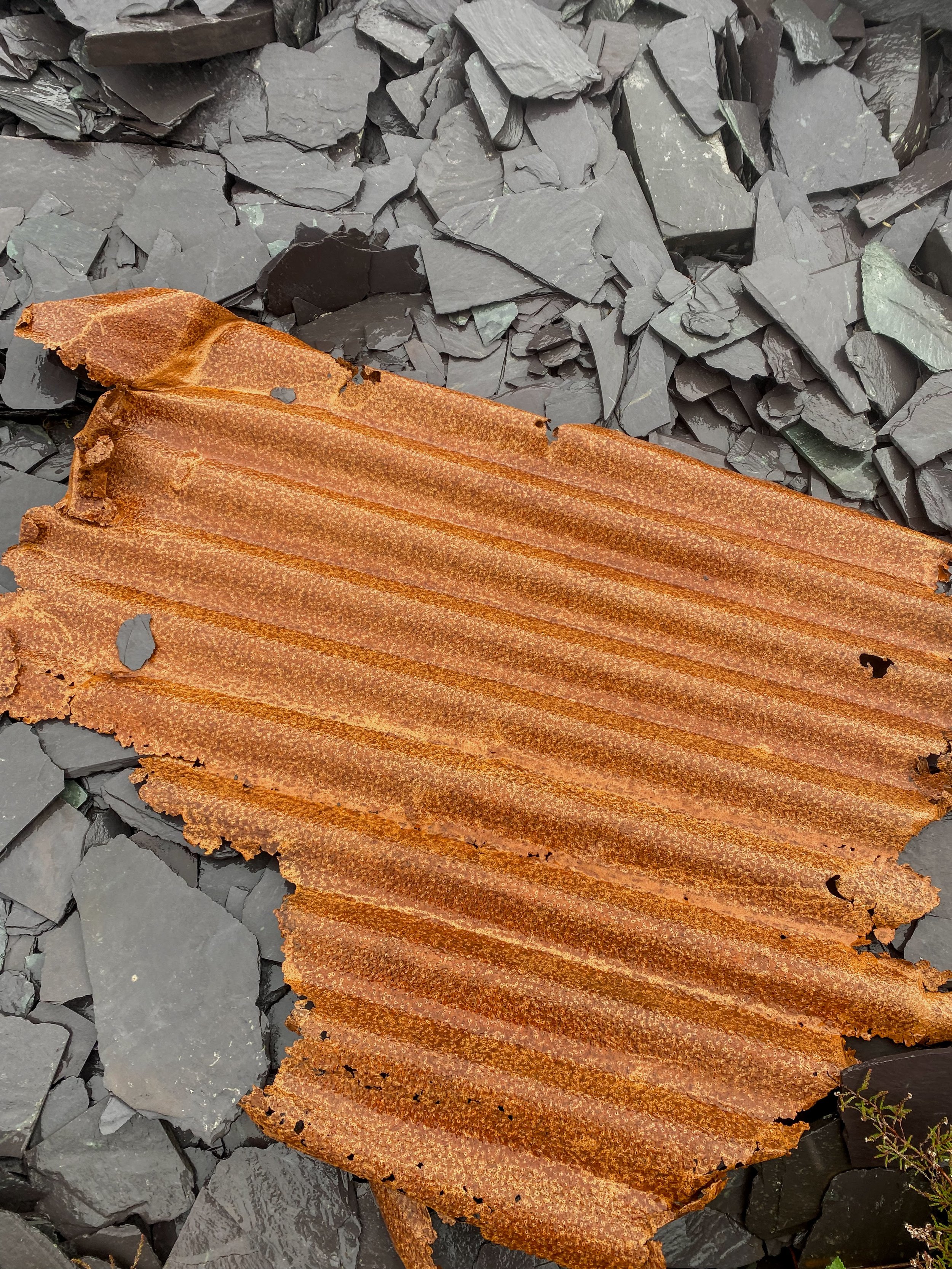
Corrugated Iron
An industrial skin returning to mineral matter
Substance
Corrugated iron is a thin profiled metal sheet manufactured to combine lightness with structural strength.
Formation
Its repeated ridges are industrially imposed, but exposure to weather gradually produces rust, stains, holes and irregular edges.
Encounter
It is encountered within temporary buildings, barriers, roofs and neglected infrastructure, places where architecture is provisional and continually exposed.
Research
Corrugated iron occupies an uncertain position between protection and vulnerability. Designed as an architectural skin, it slowly records every condition from which it was intended to provide shelter.
Translation
In Relative Permanence, rusted corrugated iron is placed against broken slate. Manufactured metal and geological fragment meet through fracture, layering and different scales of time.
Afterlife
As the iron oxidises, the industrial surface moves gradually back towards mineral matter. What once protected a structure becomes a fragment requiring its own form of support.
Status: Continuing
Corrugated Iron: Relative Permanence
Rusted corrugated iron placed across fragments of broken grey slate.
In development
Further entries will emerge as research and studio experiments develop:
Chalk · Sand · Clay · Cuttlebone · Seaweed · Lichen · Mycelium · Glass · Plaster · Packaging · Road-marking material · Asphalt · Roof tile · Paper · Paint · 3D-printed polymer